 |
 |
 |
Recently I read an article about younger generations no longer understanding the floppy disk icon depicting a save command on a toolbar. This is not strange, as they never actually had one in their hands. I however still have plenty of them in a drawer. On one disk, I found a back up of an Algol 68 Genie prototype dating back to 1994, the year Star Trek: Generations was released. Just in case someone would be interested in this early version, I converted it to an archive and posted it in the repository. I doubt whether it would compile cleanly on modern platforms, so it sits there purely for academic purposes.
At that stage, the Algol 68 Genie project did not exist by that name. The source code was developed on a Macintosh SE and back then my idea was to let the compiler generate C as intermediary code. Eventually, the Algol 68 Genie code generator became an interpreter walking the syntax tree, as I explained for instance in this interview. However, this prototype source code has an early version of Algol 68 Genie's parser, that has recently been reused for the GA68 front-end to GCC. I would not have suspected that my work would someday contribute to a compiler with the stature of GCC, but there we are.
That floppy disk with a prototype is not the only relic from A68G's early days. I also cherish my vintage Algol 68 documentation, that I used to build the Genie. Nowadays, one can simply search for documentation on-line, but that was not the case when I started working on my Algol 68 implementation. The time stamp on the files in the prototype archive says 1994. To put that into perspective, the World Wide Web started in 1991. In 1993, Adobe introduced the pdf format. It took another decade before documentation could be accessed on-line with relative ease.
You may ask where I got the publications I used for my Algol 68 project, at the time? Some you would find in your university's library. For instance, I studied Mailloux's PhD thesis in the library of the University of Twente, where I worked at the time. If a text was at another university, the librarian could request it and you patiently awaited its arrival. Others, you had to buy for courses or out of interest. And of course, you would get them from other people.
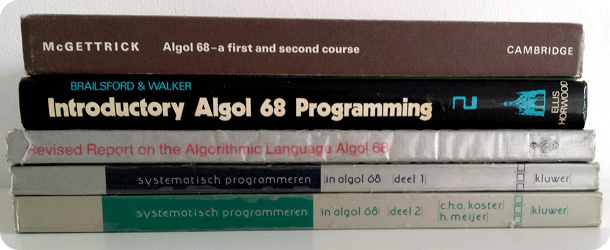
Below photo shows a stack of books in my personal library, that I used to develop Algol 68 Genie. Each book brings back memories, giving them sentimental worth that pdf files could never have. McGettrick's book I purchased in Cambridge while visiting a postdoc friend in the early 1990's. The Revised Report was donated to me, by another friend. Brailsford and Walker was a dedicated gift from one of the authors, Andy Walker, who annotated the copy for me.
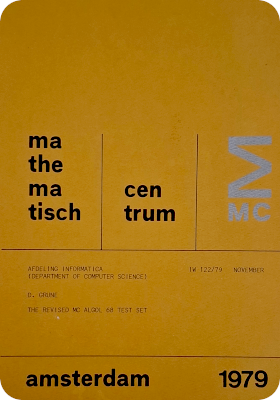
Next to language documentation, I was in need of a regression test set. A well known one was the Mathematisch Centrum Revised Algol 68 Test Set edited by Dick Grune. Before we had the internet, the test set was apparently available as point-stropped open source software avant la lettre, provided you had a mainframe with tape drive or paper tape reader at your disposal. As you will recall, I had a cute little Macintosh with a floppy drive instead.
Not to worry, via a befriended computer scientist with connections at the University of Amsterdam, I received the syllabus in below photo. I diligently typed sample programs from this publication into my computer. Those were the first entries in the test-set for the prototype implementation mentioned above, and remain in the Algol 68 Genie regression test set up to this day.
I am not a nostalgic person reminiscing that in the past, all would be better. On the contrary, many things are better today than they were back then. Still, studying in libraries, browsing book shops and working at a computer with a printed publication in your lap, does have its charms.

